导读摘要Guide Summary
这篇讲什么What This Text Addresses
历史背景Historical Background
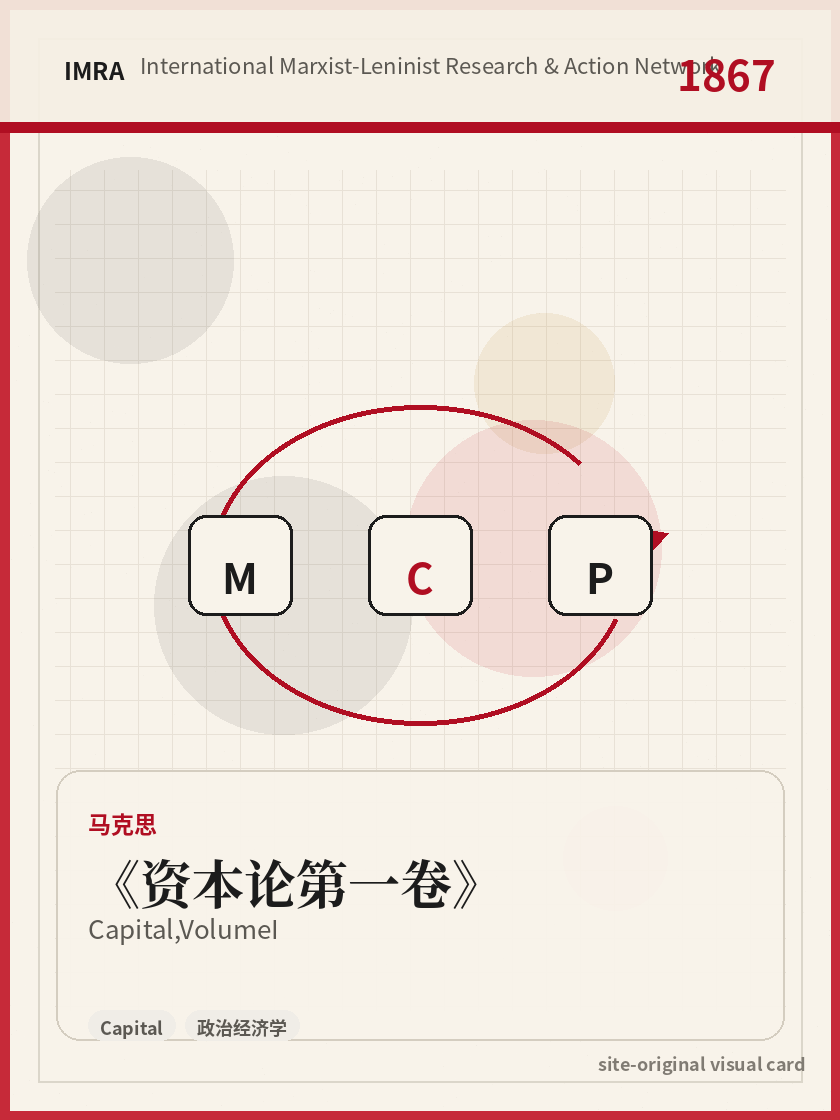
《资本论》第一卷系统分析资本主义生产过程,是政治经济学批判的核心文本。Volume I of Capital systematically analyzes the capitalist production process and is the core text of the critique of political economy.
文本结构Text Structure
从商品和货币出发,进入劳动力、剩余价值生产、工厂制度、工资形式和资本积累。It moves from commodity and money to labor-power, production of surplus value, factory system, wage forms, and accumulation.
核心概念Key Concepts
- 价值形式
- 剩余价值
- 劳动过程
- 工资形式
- 积累
- value-form
- surplus value
- labor process
- wage form
- accumulation
阅读顺序Reading Order
先通读标题、目录和推荐理由,再围绕“价值形式”“剩余价值”标注段落,最后把文本放回学习阶段任务中复盘。First read the title, outline, and recommendation; then mark passages around “value-form” and “surplus value”; finally review it through the stage task.
推荐理由与学习路径Reason and Study Path
为什么读这篇Why Read This Text
建议作为03 政治经济学:理解资本运动的阅读材料:它能帮助读者围绕政治经济学形成可核验的文本笔记。Recommended as Advanced reading: it helps place Political Economy in a systematic path. Current text status:
阅读训练Reading Training
阅读前先知道Before Reading
- 为什么必须从最抽象的商品形式开始?
- 剩余价值如何在等价交换中产生?
- 历史材料和逻辑分析如何结合?
- Why must the analysis begin with the abstract commodity form?
- How does surplus value arise within equivalent exchange?
- How do historical materials and logical analysis combine?
阅读训练Reading Training
阅读后检查After Reading
检查问题Review Questions
- 能否画出货币转化为资本的逻辑链条?
- 能否解释绝对和相对剩余价值?
- 能否说明资本积累如何再生产阶级关系?
- Can you diagram the transformation of money into capital?
- Can you explain absolute and relative surplus value?
- Can you show how accumulation reproduces class relations?
常见误区Common Misreadings
- 把《资本论》读成经济学教材而忽视社会关系批判。
- 只记概念定义而不追踪概念运动。
- 把历史章节当作可跳过的例子。
- Reading Capital as an economics textbook while missing its critique of social relations.
- Memorizing definitions without following conceptual movement.
- Treating historical chapters as dispensable examples.
本阶段学习任务Stage Task
建立个人《资本论》阅读索引:每章记录核心问题、关键概念、一个现实材料例子。Create a personal Capital reading index: for each chapter note the core problem, key concepts, and one contemporary example.
公开来源入口Public Source Entries
从可追溯来源开始阅读Start from Traceable Sources
本站优先提供作品导读、版本说明、引用格式和可追溯的公开来源入口;未核验为公版或授权的全文不复制到站内。This site prioritizes work guides, edition notes, citation format, and traceable public source entries; unverified or unauthorized full texts are not copied locally.
引用格式Citation
马克思:《资本论第一卷》,1867。国际马列主义研究与行动网络:https://imra-network.org/articles/marx-capital-vol1.html
导读来源说明Guide Source
导读如何生成How This Guide Was Prepared
该导读参考公开档案、来源页、作品元数据和本站已有摘要改写,不复制外部导读原文。This guide paraphrases public archive/source information, catalog metadata, and site summaries without copying external guide text.
该导读已完成编辑复核。This guide has completed editorial review.
查看依据来源Open guide/source reference引用工具Citation Tool
复制引用格式Copy a citation format
引用前请同时记录访问日期,并根据你所在机构要求调整格式。Record your access date and adjust the format to your institution's rules.
GB/T 7714
中文文献格式Chinese citation format
马克思:《资本论第一卷》,1867。国际马列主义研究与行动网络,https://imra-network.org/articles/marx-capital-vol1.html。
MLA
Karl Marx. "Capital, Volume I." International Marxist Reading Archive, 1867, https://imra-network.org/articles/marx-capital-vol1.html.
Chicago
Karl Marx. "Capital, Volume I." International Marxist Reading Archive. Accessed June 21, 2026. https://imra-network.org/articles/marx-capital-vol1.html.
版权与版本风控Copyright and Version Risk默认折叠,供来源核验和编辑维护使用Collapsed by default for source verification and editorial maintenance
作者原作按 life+70 初筛已进入公版候选,但当前译本、选集、注释、导读和具体版本仍需逐项核验;本站暂以导读和公开来源入口为主。The author's originals are public-domain candidates under a life-plus-70 screen, but translations, collected editions, annotations, guides, and specific editions still need item-level verification; this site currently prioritizes guides and public source entries.
本站不直接复制未核验全文。对已公版并核验的文本,提供本地全文;对版权或译本状态不明的文本,提供元数据、本站原创导读和公开来源链接;对仍受保护的文本,只提供介绍、必要短引和外部合法来源。This site does not copy unverified full texts. Verified public-domain texts may be hosted locally; texts with unclear copyright or translation status receive metadata, site-original guides, and public source links; protected texts receive introductions, limited short quotation where appropriate, and lawful external sources only.
读完你应该能回答什么What You Should Be Able to Answer
阅读后问题Reading Outcome Questions
- 《资本论第一卷》是在回应什么历史处境、理论争论或组织问题?What historical situation, theoretical debate, or organizational problem does Capital, Volume I address?
- 它如何说明资本、工资、价值、积累或危机不是单纯经济数字,而是社会关系?How does it show capital, wages, value, accumulation, or crisis as social relations rather than merely economic numbers?
- 它的核心论证分几步推进,哪些概念不能只按口号理解?What are the main steps in the argument, and which concepts should not be reduced to slogans?
- 哪些判断需要回到具体版本、来源和写作对象中核验?Which claims need to be checked against the specific edition, source, and intended audience?
常见误读Common Misreadings
不要这样读Avoid These Readings
- 不要把文本只当作脱离历史处境的口号或结论表。Do not treat the text as a list of slogans detached from its historical situation.
- 不要把剩余价值、工资或资本关系简化为普通低工资问题。Do not reduce surplus value, wages, or capital relations to a simple low-wage problem.
- 不要把公开链接可访问误认为版权、译本或版本身份已经授权。Do not confuse a reachable public link with copyright, translation, or edition authorization.
文本关系网Text Network
把这篇放回思想网络Place this work back into the network
相关作者Related authors
相关专题Related topics
继续阅读Next reading
- 雇佣劳动与资本Wage Labour and Capital · 政治经济学Political Economy
- 工资、价格和利润Value, Price and Profit · 政治经济学、战略与路线Political Economy, Strategy
- 哥达纲领批判Critique of the Gotha Programme · 国家理论、政党理论State Theory, Party Theory
- 英国工人阶级状况The Condition of the Working Class in England · 政治经济学、历史研究Political Economy, History
反馈与维护Feedback and Maintenance
提交错误、来源、版权请求或参与复核Submit corrections, sources, rights requests, or review help
请同时提供作品 ID、具体页面 URL、问题位置、来源证据和联系方式。未经核验的来源不会被标记为精确来源。Please include the work ID, page URL, location of the issue, source evidence, and contact details. Unverified sources will not be labeled exact.